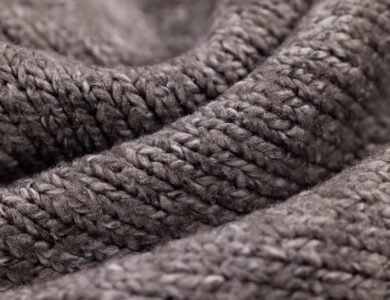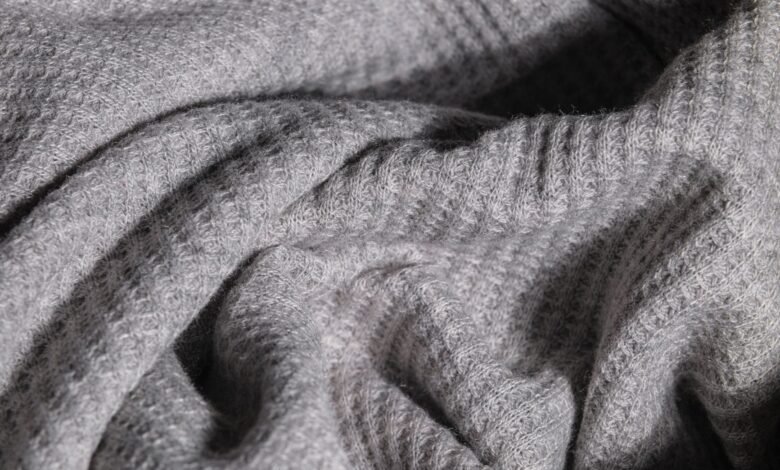
Two cashmere sweaters at $250 can feel completely different after two weeks because one uses 14.5-micron fibers in a dense, tightly-knit fabric and the other uses 16.5-micron fibers in a loose, lighter knit — the finer, denser knit holds shape and resists pilling, while the coarser, looser knit thins and pills at friction points. Price tells you nothing about micron or density, which are the real predictors of softness and longevity.
Softness comes from fiber diameter, not from being cashmere alone, and durability comes from how much fiber mass and twist sits in each square meter, not from a brand story. You can estimate both before buying by checking the knit tightness and doing a gentle stretch recovery test; a quality cashmere springs back without showing bright gaps. The breakdown below shows what micron range and GSM to look for and how to read them without a lab.
Why cashmere softness is a micron number first
Cashmere softness is governed by fiber diameter measured in microns. Grade A cashmere is typically 14-15.5 microns, Grade B 15.5-18.5 microns, and above 19 microns you start losing the characteristic cashmere hand and get itchy prickle because thicker fibers bend less easily against skin. The lower the micron, the more easily the fiber bends, so the softer it feels.
Two sweaters labeled 100% cashmere can both be honest and yet feel different because one uses 14.2-micron inner-coat fibers and the other uses 16.8-micron fibers that still qualify as cashmere but are closer to fine merino in hand. Staple length matters too — longer staples (34-42mm) mean fewer fiber ends poking out, so less pilling and less halo frizz after washing. Short staples (below 30mm) create more free ends even if micron is low.
Why weight decides whether soft cashmere lasts
GSM for cashmere is tricky because cashmere is knit, not woven, but weight still signals fiber mass. A single-ply 220 GSM crewneck uses less yarn and often looser tension to achieve softness cheaply, which means it bags at elbows and shows wear at cuffs within 10-15 wears. A two-ply or tight single-ply at 280-340 GSM uses more fiber, more twist, and tighter loop density, so it resists stretching and pilling longer.
The trade-off: above about 360 GSM for a crewneck, cashmere gets hot and heavy for indoor wear, though it works for outer layers and cardigans. For everyday sweaters, 280-320 GSM with 2-ply construction hits the sweet spot — enough mass to hold shape, not so much that it sags.
Slider visual linking fiber diameter in microns to perceived softness and required fabric weight for longevity.
How to evaluate cashmere in store without a label
1. Stretch and light test
Hold the front panel to light and stretch 10% sideways. Good 280+ GSM cashmere shows a uniform dim glow with small, even loops. If you see bright elongated gaps, the knit is too loose and will bag. Count to two after release — it should snap flat immediately.
2. Palm friction and pilling check
Lightly rub the underarm area with your palm for 5 seconds. Short-staple cashmere will already show faint fuzz balls forming. Long-staple, higher-twist yarn resists this. If pills form instantly in store, they will multiply after first wash.
3. Ply and seam inspection
Check inside cuff or hem. 2-ply shows two yarns twisted together at cut edge, not just a folded single yarn. Linking at shoulders should be even, not wavy. Uneven linking signals low tension control and future shape loss.
Four-quadrant comparison showing how micron and GSM together predict cashmere longevity.
The verdict at same price
When two cashmere sweaters share a $250 tag, ignore marketing copy and check two numbers you can estimate by hand: micron via softness and prickle, and GSM via pinch thickness and light test. A fine 14-15.5 micron yarn at 280-320 GSM in 2-ply will outlast a coarse 16.5+ micron yarn at 220 GSM in single-ply by roughly 3x wears, even though both say 100% cashmere. Choose fine plus dense for luxury that lasts, or coarse plus dense for daily resilience. Avoid fine plus light unless you accept a short lifespan.
Frequently Asked Questions
Does higher ply always mean better cashmere?
Two-ply is generally more durable than single-ply at same fiber quality because it adds twist and mass, but a tight, high-twist single-ply at 300 GSM can outperform a loose 2-ply at 240 GSM. Check loop density and recovery, not just ply number.
How can I tell cashmere micron without a lab?
You cannot get exact microns, but you can bracket it. If it feels buttery with zero prickle against inner wrist and shows almost no halo, it is likely under 15.5 microns. If you feel slight prickle and see more halo, it is likely 16+ microns.
What GSM should a cashmere sweater be?
For everyday crewnecks, 280-320 GSM. Below 250 GSM it will be delicate; above 360 GSM it is better suited to outer layers. Cardigans and turtlenecks can go slightly heavier because seams support shape.
Why does my new cashmere pill after one wear?
Short staple length and low twist create free fiber ends that tangle quickly. It is not always poor quality, but early heavy pilling usually signals staples under 32mm. Gentle de-pilling with a sweater stone after first two washes often reduces future pilling as loose ends are removed.