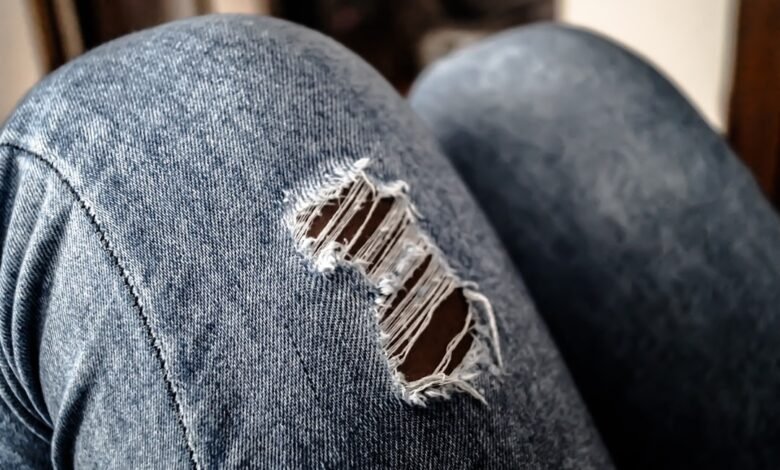
Price alone does not decide when jeans tear at the crotch, construction and fit tension decide more than brand tier. The inner thigh rubs constantly and the center seam takes your full pull when you sit, so yarns thin and slip there first. That is why crotch fails before knees or hems, which bend but rarely rub hard together.
Heavier denim often resists rub longer, but it can still fail early when sixteen plies stack at the crotch and trap stress. If white weft shows after a few months, that is warp crowns abrading and lighter core showing — explains the faded patch before a hole. The short answer to why do jeans tear at the crotch comes down to a warp float that sits proud and a sixteen-to-nine ply switch you can spot in ten seconds — here is how to read it.
Why the crotch wears out before knees or hems
The first surprise is how denim is built to fail at that spot. Most jeans use 3/1 right-hand twill, where the warp floats over two to four weft yarns before diving under. Those floats sit proud of the surface, so they take thigh-to-thigh rub first, and repeated friction abrades the warp crowns until the underlying weft shows.
Dirt, sweat and moisture stay trapped in that warm zone and can weaken cotton over time, which accelerates fiber breakage compared with the knee that mainly bends. This is why inner thigh looks thin while the rest still looks new. The mechanism is that twill weave floats absorb abrasion because the raised warp yarns absorb contact before the hidden weft does.
In Bogleheads.org, wearers described the same pattern across brands: after about a year inner thigh lower crotch wears thin then holes while the rest looks new. As one poster described it, “inner thigh lower crotch area will wear thin”. The fix that came up was switching to a looser cut or reinforcing early with an iron-on patch before a hole shows, which works because reducing contact and adding a second layer lowers direct warp-float abrasion. That aligns with what is known about crotch blowout from friction where friction and movement concentrate at the junction.
Magnified diagram showing warp yarns floating over weft in 3/1 twill and where thigh-to-thigh rub contacts the float crown first.
Fabric thinning vs seam opening — two different ways jeans fail at the crotch
Two failures look similar from outside but need different fixes. Fabric thinning is fiber breakage. Seam slippage is yarns sliding apart without breaking. The sewn seam strength and yarn slippage method describes this distinction, where force applied perpendicular to sewn seams can cause displacement of warp or filling yarns.
Per that method, a seam can fail three ways: sewing thread rupture, fabric rupture at the seam, or slippage where yarns displace and leave a gap. In a crotch, tight fit increases perpendicular tension on the inseam and center junction, so slippage can open before the fabric itself holes. You can tell the difference by eye: thinning shows a diffuse white weft haze, slippage shows ladder-like yarn separation along the stitch line with thread still intact.
In AnswerOverflow mfad, posters noted the same blowout across denim, chinos and linen regardless of brand. As one poster described it, “always rub away the crotch on any pants”. The advice from tailors there was to check rise and inseam seams for yarn separation and reinforce before a hole, not just patch fabric. That matches seam slippage measurement where elongation of fabric with seam versus fabric alone is compared to isolate slippage.
Two panel diagram comparing thinning warp float with broken fibers versus seam slippage showing yarns displaced along stitch line with gap.
How tight fit and low rise increase tensile load at the crotch seam
Tight fit adds pull where you do not see it. Slim and skinny cuts increase tension perpendicular to the inseam and the center front and back junction, so every step pulls yarns sideways at the crotch point. That same tension makes slippage more likely because yarns are already under load when thigh rub starts.
Low rise makes it worse in a different way. When jeans sit low and sag slightly, fabric bunches at the crotch, which increases contact area and shear with each stride. Cycling and stairs concentrate the same bunching into repeated friction in one spot. The trade-off is clear: a fit that feels flattering standing can create peak stress seated.
Warmth and grit add a chemical assist. Tight fit leaves almost no air gap, so sweat and fine dirt stay in the crotch and can weaken cotton over time, which is why regular washing to remove grit can slow thinning. The link between slim fit and low rise increase crotch stress is well described where slim-fitting jeans and lowriding sagging cause fabric bunching and concentrate abrasion.
At the inner thigh seam junction, look for yarn movement versus firm lock by pinching the seam and trying to slide layers perpendicular to the stitch line, and check for a white streak at the crotch point where warp is already abraded. If layers shift easily or you see whitening, tension is already high and reinforcement early can help.
What denim weight in ounces and GSM actually predicts for blowout resistance
Weight alone does not guarantee durability, but it sets a useful baseline. The mass per unit area test defines how GSM is measured, typically by cutting a 100 square centimeter sample, weighing it, and multiplying by 100. In the US, denim is often sold in ounces per square yard.
One ounce per square yard is approximately 33.91 GSM, per the ounces to GSM conversion guide. Levi’s considers 10.5 to 12.5 ounces as midweight, which converts to approximately 356 to 424 GSM. That same guide notes recent 501 Original production using fabric weighing 12.9 ounces, approximately 437 GSM.
Heavier cotton denim typically shows higher abrasion resistance in manufacturer lab data, with an example band where 10 ounce 100 percent cotton shows approximately 12,000 cycles, 12 ounce approximately 15,000 cycles, and 14 ounce approximately 18,000 cycles, per the Martindale cycles by denim weight example band. Heavier weight resists rub longer, but it adds heat and stiffness, and stretch blends can lose cycles because elastane can break under heat and tension.
Slider showing denim weight in ounces converting to GSM and corresponding Martindale abrasion cycle band from manufacturer data.
Gusset versus flat-felled seam — why construction changes where stress goes
Even heavy denim can fail early if all seams meet at one stiff point. Standard jeans have front, back and two inseams meeting at the crotch, and flat-felled seams there can create eight plies in the legs and sixteen plies at the crotch point. That bulk is stiff and concentrates stress right where thighs rub.
A diamond gusset changes the load path. It inserts a delta-shaped piece where the inseams meet, so seam lines radiate around the gusset instead of converging. Per the diamond gusset redistributes stress maker, the result is three-ply leg seams and only nine-ply at the crotch, not sixteen, which reduces stiffness and spreads pull. Dovetail Workwear similarly notes a full diamond-shaped gusset sewn into where leg inseams meet strengthens by redistributing stress points so gusset eliminates four seams at one point.
Manufacturers often avoid flat-felled on the inseam where eight layers must be sewn through in the crotch and use it at the seat where twelve layers meet, per the flat-felled seam layer count at crotch note. For you, the takeaway is simple: fewer layers at one point means less stiffness and less stress concentration, which can slow both thinning and slippage.
Table comparing flat-felled sixteen-ply crotch stack versus diamond gusset nine-ply distribution and where each construction works best.
Levi’s, Everlane and Good American — what their published specs tell you about crotch durability
This comparison is a research-based analysis from publicly available specs, not a lab review. It shows how weight, fiber and construction notes from the brands themselves can hint at crotch durability when read together.
Levi’s 501 weight in ounces is typically listed as midweight 10.5 to 12.5 ounces, with recent production noted at 12.9 ounces in conversion guides. That puts it at approximately 356 to 437 GSM. It is 100 percent cotton ring-spun with a classic flat-felled seat seam and the traditional four-seam crotch intersection.
Pros: authentic rigid hand and good abrasion baseline for its weight. Cons: sixteen-ply bulk at crotch can concentrate stress and may fail earlier under tight fit despite heavier weight, which is a genuine reason not to buy if your primary goal is maximum crotch longevity on a mesh office chair.
Everlane Rigid Way-High lists Everlane rigid 13 oz denim as rigid 13 ounce denim with no stretch, 100 percent organic cotton. That is approximately 441 GSM, slightly heavier than Levi’s midweight. Pros: heavier weight can support higher Martindale band in manufacturer example data and no elastane means no elastane breakage. Cons: rigid non-stretch can increase perpendicular seam tension if fit is skin-tight, which can accelerate slippage.
Good American Weightless Wide lists Good American Tencel blend composition as 51 percent cotton 49 percent Tencel lyocell, weightless rigid for shape retention with a lighter hand. Pros: Tencel lyocell improves drape and can reduce bunching, and shape retention can keep rise from sagging. Cons: lighter hand may show lower abrasion band than 13 ounce cotton in manufacturer examples, and light weight alone does not prove durability without gusset or reinforcement. For cotton sourcing context, Better Cotton Initiative sourcing context is a program where brands join to drive demand for cotton farmed more responsibly.
Table comparing three published weight and fiber specs with construction notes that affect crotch stress distribution.
Where most buyers go wrong on weight as durability proof
Higher GSM alone misleads because stretch elastane reduces abrasion cycles despite higher weight, and Tencel lyocell changes hand and drape but not Martindale linearly. The sixteen-ply bulk can out-fail a lighter gusseted pair because stiffness concentrates pull at one point. Read seam type plus fit tension plus weight together, not weight alone, which is why two jeans at the same ounce can wear very differently at the inner thigh.
How to spot blowout risk before you buy and slow it down after
Spot risk in the fitting room before the jeans become a favorite. Choose a rise that does not bunch at the crotch when seated, and a thigh that skims rather than pulls tight. Look for a gusset or at least bar-tack reinforcement at the crotch junction, which spreads load.
Sit down in the fitting room. If the rise bunches or pulls at the crotch when seated, size or cut is wrong.
Check for a gusset or bar-tack reinforcement here. At home, check monthly for white weft showing through.
Should skim, not pull. If seams whiten under tension when you sit or stand, size up.
Sit down in the fitting room. If the rise bunches or pulls at the crotch when seated, size or cut is wrong.
Check for a gusset or bar-tack reinforcement here. At home, check monthly for white weft showing through.
Should skim, not pull. If seams whiten under tension when you sit or stand, size up.
Diagram of jeans marking three fitting-room and at-home checks: rise and waistband, the crotch and gusset junction, and the inner thigh
Wash more regularly to remove grit that weakens cotton, because dirt and moisture weaken crotch fabric where friction and moisture combine to break fibers. Cold wash inside-out helps protect color and elastane if present, and avoid high heat tumble that can set elastane shrinkage and bake in a crotch crease that abrades faster. Do not bleach Tencel lyocell or elastane blends, as bleaching weakens cotton warp and can accelerate blowout.
Try this before you buy: sit and stand in the jeans and watch the inner thigh — if fabric pulls tight and seams whiten under tension, size up or try a higher rise. At home, check inside crotch monthly for white weft showing, which signals warp crowns already abrading. Early reinforcement with an iron-on patch inside can extend life before a hole forms.
Denim reinforcement decision tree — when to reinforce, darn or replace
Spotting thinning early only helps if you know which fix matches which stage. This decision tree is a self-authored practical evaluation tool created for this guide based on the ASTM D1683 seam failure modes and Martindale abrasion bands above, not a published industry standard. Use it as an in-store quick-check and at-home care guide.
If you see faint fading but no white weft and no seam gap, reinforce now. Apply an iron-on patch inside the crotch before a hole appears, using a patch method where scrap denim larger than the thin zone is secured with zigzag stitch to prevent further wear, per the denim patch repair method description. Estimated wear remaining can be approximately 80 to 150 wears depending on fit and weight, which keeps cost-per-wear low.
If you see white weft and a small hole under one centimeter with intact surrounding fabric and no yarn slippage along the stitch line, darn. The crotch reinforcement and darning methods approach weaves new threads across the thin area with a sewing machine, which restores some cover factor. This is typically best for expensive jeans where the rest of the jean still looks new.
If the hole is over two centimeters plus yarn slippage where yarns have displaced along the seam, replacement or a full gusset rebuild by a tailor is the practical call. The Martindale abrasion tester method is the standard method for measuring abrasion resistance of textile fabrics, but it does not set a universal wear-count threshold, so any month estimate should be conditional. For related guidance on repair economics, see our guide on when it is worth repairing clothes versus replacing them. When replacing, consider sourcing context such as Better Cotton where brands publish it, which speaks to cotton sourcing, not to abrasion performance.
Where most buyers go wrong
Check seam type and fit tension before you trust weight alone, because crotch blowout comes from warp floats abrading under thigh-to-thigh rub plus seam slippage under perpendicular pull. The single most useful action is to test fit seated for whitening and look for a gusset that cuts sixteen plies to nine. Ignore that and even heavy 13 ounce denim can thin in months, follow it and a midweight pair can stay intact much longer.
Frequently Asked Questions
Does wearing a larger size prevent crotch blowout if my thighs touch?
Sizing up can reduce perpendicular tension on seams, but it does not eliminate thigh-to-thigh rub if contact remains, so abrasion can continue. Proper rise, a gusset, and regular washing to remove grit help more than size alone, because fit and crotch stress increase with slim and low-rise sagging that bunches fabric.
How do I tell if my jeans need reinforcement now versus later darning?
If white weft is just visible with no hole and no seam gap, iron-on patch inside now to add cover. If a small hole under one centimeter appears with intact surrounding fabric, darn across the thin zone rather than waiting for the hole to grow.
Are 100 percent cotton jeans more resistant to crotch blowout than cotton-Tencel or stretch blends?
Published example bands suggest 12 to 13 ounce 100 percent cotton can show higher Martindale cycles than lightweight Tencel blends, but Tencel blend lightweight shape retention improves drape and reduces sagging. Stretch blends can lose recovery with high heat, which may increase slippage, so pros and cons matter more than absolute ranking, and Better Cotton sourcing speaks to sourcing, not abrasion.