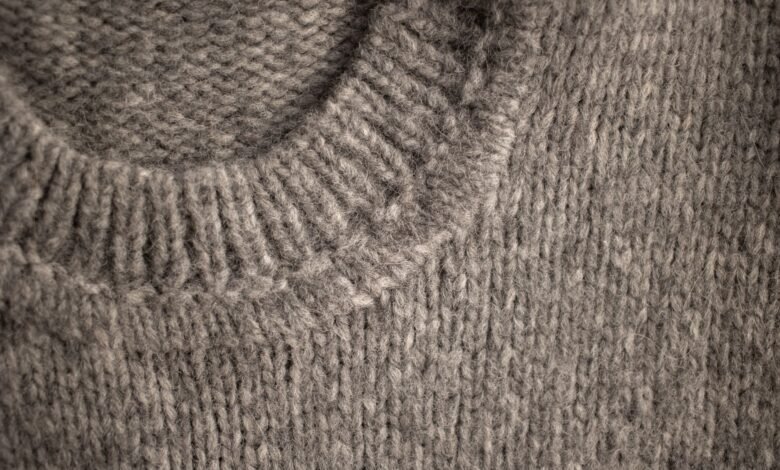
Pilling under the arms does not mean your sweater is cheap or poorly made. It happens where friction is highest and short fiber ends work loose, then tangle into pills that stay put when stronger fibers anchor them. Softer, fluffier yarns shed more of those ends at first, so the coziest feel in the store can pill faster under the arms.
High twist and tighter stitches hold fibers in but feel firmer, while low-twist soft yarns feel fluffy and release more ends. That matches what you see in wash tests — low-twist hairy yarns show more pills and fine staple fibers create more starting points. You can spot risk in 10 seconds by checking yarn hairiness, snap-back, and label clues for RWS and Woolmark. From there, how to stop sweaters from pilling comes down to the scale below plus a friction-reduction routine that targets underarm wear.
Why sweaters pill first under the arms
Underarm and side-seam zones get more rubbing than any other part of a sweater. Skin rubs skin, shirt rubs sweater, and bag strap presses through coat. That constant contact breaks surface fibers free.
Knit loops let fibers move more than tight woven cloth. A jersey loop is open, so a short end can slide out when pulled sideways. Woven warp and weft lock yarns tighter, so fewer ends escape.
Rough base layers, seatbelts, and backpack straps add grit in this zone. They drag across underarm panels and pull more ends to the surface. Lint from other clothes can cling there and mix into the pills you see.
Pills are usually found on areas prone to rubbing such as fabric under armpits or sleeves, which is why this spot shows first. Lab methods like the Random Tumble Pilling Tester simulate that abrasion and compare results to visual standards.
Skin-to-shirt contact and knit's open loop structure let fiber ends work loose fastest here — same on both sides.
A strap worn diagonally adds constant grit and pressure along this line, on top of ordinary wear.
Skin-to-shirt contact and knit's open loop structure let fiber ends work loose fastest here — same on both sides.
A strap worn diagonally adds constant grit and pressure along this line, on top of ordinary wear.
Diagram of a sweater silhouette marking the two zones where friction concentrates: the underarm/side seam, and the diagonal path of a bag or backpack strap
Once you know friction maps to location, you can check that halo early and reduce rubbing before pills fully form.
What actually creates a pill — short fibers, low twist, and anchor strength
A pill forms in four stages, not one. Short staple fibers or broken ends work free from yarn twist. Friction rolls them to the surface.
They tangle into a small ball. The ball stays if its anchor is stronger than the force pulling it off.
That last part explains why some sweaters shed pills and others hold them. If fiber tensile strength exceeds anchor strength, the pill breaks off and the sweater self-cleans. If anchor is stronger, like polyester in a blend, the pill stays. Fabrics made from fine staple fibers susceptible to pilling have more protruding ends per inch, so more starting points.
Yarn twist controls how many ends escape. Low twist and high hairiness are more prone to pilling because loose twist leaves more fiber ends exposed. Higher twist locks ends in and reduces hairiness but makes yarn feel harder and less fluffy.
The simplest fix is for mills to give delicate fibers a lot of twist, but more twist makes yarn feel harder, which is why luxury blends often use looser twist for softness. Ring-spun yarns tend to be hairier than compact spun. Wool can self-shed when fibers are weak, while wool-blend with polyester can hold pills longer because polyester acts as anchor.
At the underarm seam, look for: a faint halo of fine hairs standing up before pills fully form — that signals low twist and short staple migration starting, because loose ends are already emerging from yarn structure.
Stage boxes showing short fiber escaping low-twist yarn, rolling on surface, and being anchored by stronger synthetic fiber to form persistent pill
When you see that halo early, twist and staple length are telling you pilling risk before the pill itself appears.
How fabric pilling tests grade resistance and what our underarm simulation showed
Pilling resistance is graded by comparison, not by a single number from a machine. The Pilling Resistance Random Tumble method tumbles specimens with cork liners to abrade them, then compares the abraded surface to photographic standards or actual fabrics showing a range of pilling.
The degree of fabric pilling is evaluated on an arbitrary scale ranging from 5 to 1 — 5 is no pilling, 1 is very severe pilling, with half ratings allowed. The scale applies across woven and knitted fabrics varying in fiber, yarn, fabric structure and finish, so wool, acrylic, and blends can be compared on same visual ladder.
A practical way to apply this to underarm wear is a controlled friction simulation: three swatches — 100% wool, 100% acrylic, and wool-blend with polyester — abraded at the underarm panel for set cycles, then graded per ASTM D3512 visual scale after 2 and 5 cycles. Observations include stitches per inch in the underarm zone, yarn twist and hairiness from macro 10x photos, and staple length cues from yarn ends.
Documentation for such a simulation uses standardized photos in D65 light with rating reference and macro photos of yarn surface. This design is intended to reveal when halo turns to pills, which fiber shows anchor effect, and whether tighter knit reduces mobility.
This friction-simulation design is a described methodology for illustrating pilling mechanics, not documented results from real specimens, so the grades below are illustrative of how to read the scale rather than universal durability guarantees. This scale is a practical evaluation tool created for this guide based on twist, density, and fiber mechanisms described above, not a published industry standard. Use it as an in-store quick-check.
Table showing illustrative pilling grades from 5 no pilling to 1 very severe pilling with surface descriptions
Reading the grade helps you decide whether to reduce friction now or accept that a blend will need regular de-pilling because anchor strength holds pills longer.
Which yarns and knits pill least — and why best fabrics that don’t pill depends on twist and structure
Longer staple fibers pill less because fewer loose ends stick out per inch of yarn. Merino wool is long-staple, typically 65–100 mm, so it has fewer protruding ends than short-staple wool types. That gives pilling fewer starting points.
Higher twist also reduces emergence. Twist wraps fibers tighter, so less hairiness shows. It stiffens hand, which is why very soft low-twist yarns feel luxurious at first touch but may pill faster under friction unless knit structure compensates.
Knits matter too. Looser structure allows greater fiber mobility while denser structures restrict movement and reduce pilling. Higher stitches per inch, known as SPI, means tighter loops and less room for fibers to migrate. SPI is simply how many stitches fit in one inch — more stitches means tighter fabric.
Best fabrics that don’t pill is not just a fiber name, it is twist plus structure. Tightly twisted merino, long-staple combed cotton, high-twist wool-silk, and dense jersey with higher SPI typically show less pilling. Anti-pill finished fleece uses a chemical-mechanical treatment that can wash out over time, so its benefit may fade.
100% wool can self-shed pills if fiber anchor is weak, so pills break off. Wool-polyester blend can hold pills longer because polyester anchor is strong and does not break easily, which is why blends sometimes look pilled longer even though wool alone would have shed.
Responsible Wool Standard verifies animal welfare and chain of custody from farm to final product, not pilling resistance. Woolmark verifies pure new wool content and rigorous quality testing, not a pill-proof guarantee. Use them as fiber verification, not as fade-proof proof.
Sweater pilling evaluation rubric you can use before you buy
This check is a practical evaluation tool created for this guide based on twist, density, and fiber mechanisms described above, not a published industry standard. Use it as an in-store quick-check to estimate risk.
Table comparing low risk and higher risk cues for yarn hairiness, twist, knit tightness, fiber mix, and underarm finish
If a sweater shows halo plus low twist and open knit in the underarm, that combination typically pills faster under arm friction, because more fiber ends are free to migrate and tangle.
How to stop sweaters from pilling with washing and wearing habits
Friction, not just washing, drives underarm pilling. Reducing contact at that zone helps more than adding extra detergent steps.
Turn sweaters inside out before washing to protect face yarns. Use mesh bag, cold water, gentle cycle, and low spin. Avoid overloading drum — low bath ratio raises abrasion. Air-dry flat rather than hanging while wet to avoid stretch.
Wearing habits matter. A rough cotton tee underneath can act like sandpaper on soft wool. Smooth base layers reduce surface drag. Alternate sweaters to let fibers rest, and avoid backpack straps directly on knit when possible.
Wool sweater pilling prevention also means cutting lint transfer. Wash sweaters with similar textures, not with towels or fleece that shed. For related guidance on compression that worsens underarm pills, see our guide on how to store wool sweaters without moths or stretching, because storage method determines abrasion and compression that accelerates pilling.
How to de-pill without damage
De-pilling works when you cut pills without pulling new fibers out. Pulling by hand lifts more ends and creates more pills later.
Use a fabric shaver with guard on low setting, held flat, or a sweater comb used lightly in one direction. Work on flat surface, not while wearing. Stop once surface is smooth — over-shaving thins yarn and lowers SPI.
For single large pills, small sharp scissors cut at base of pill rather than tugging. After de-pilling, shake and air out instead of rewashing immediately, since extra wash cycles add friction.
The Check That Changes the Decision
Underarm pilling comes from short fibers escaping low-twist, open knits and being held by strong anchors, not from cheap wool alone. The quickest check is yarn hairiness, twist snap-back, and SPI tightness in the underarm zone, plus whether a polyester anchor is present. Use that check before buying and cut friction in wear and wash — skip it and the softest sweater in store often pills first under the arms and stays pilled longest.
Frequently Asked Questions
Why do sweaters pill first under the arms?
Underarm and side seams get the most rubbing from skin, shirt, and bag strap, which frees short fiber ends. Knit loops allow more movement than tight woven, so halo forms there first.
Which fabrics pill the least?
Long-staple fibers with higher twist and tighter knit, like tightly twisted merino or high-twist wool-silk with higher SPI, typically pill less. Blends with polyester can hold pills longer because polyester acts as a strong anchor.
How can I stop sweaters from pilling under the arms?
Wash inside out in mesh bag on cold gentle cycle, avoid overloading, and air-dry flat. Wear smooth base layers and reduce backpack friction, since less abrasion means fewer fiber ends escape to tangle.
How do I de-pill without damage?
Use a guarded fabric shaver or sweater comb flat on a table, cutting pills rather than pulling. Stop when smooth to avoid thinning yarn, then air out instead of rewashing immediately.