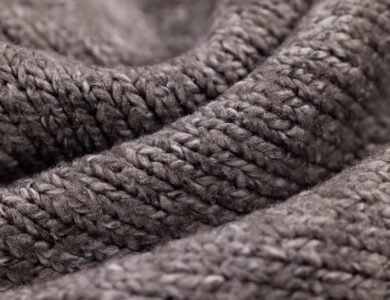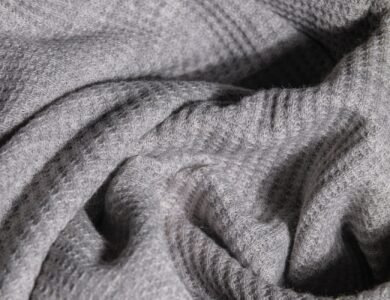
Two $80 ponte trousers can behave like two different garments because one uses denser double-knit loops, enough elastane for real snap-back, and enough weight to hold a tailored line, while the other trims weight and elastane to protect margin. That difference shows up as knee bagging by wear six and pilling in the seat and inner thigh by wear ten, not as a subtle comfort preference.
A heavier feel is not automatically better — above about 380 GSM ponte gets stiff and hot for trousers — which is why weight has to be read with loop tightness and recovery. You can spot it before buying by holding the fabric to light and stretching the knee to watch how fast it springs back. Once you know the pinch test, the light test, and what 5% elastane actually feels like in hand, you can tell in 30 seconds which pair is built to last 80 wears and which will quit at 15.
Why do two ponte trousers at the same price wear so differently?
Ponte is a construction method, not a quality grade. True ponte is made on double-jersey machines with two needle beds knitting two layers at once that lock together, so the front and back look identical and the edges do not curl. That interlocked double-knit structure gives ponte its stability for trousers, treggings, and structured dresses. When a brand labels a single-knit with different face and back stitch patterns as ponte, it will drape like heavy jersey and lose its line by lunchtime.
At the $60 to $100 tier, cost differences rarely come from design. They come from yarn mass and fiber choice. A manufacturer can hit $80 retail with a 330 GSM rayon-nylon-spandex fabric that uses more yarn per meter and 5% spandex, or with a 275 GSM polyester-rayon-spandex that uses 20% less material and cheaper short-staple polyester.
Both look polished on the hanger because ponte’s smooth double-face hides loose work. The failure only appears under daily tension and friction.
That is why comparing ponte trousers requires four signals, not one: true double-knit verification, fabric weight in the trouser window, elastane percentage for recovery, loop density for abrasion resistance, and fiber blend for pilling risk. Price alone does not predict any of them.
What GSM range keeps ponte trousers structured without feeling stiff?
GSM measures grams per square meter — the physical yarn mass. For ponte, mills typically list 330 to 400 GSM as the medium-to-heavy workhorse because that mass resists gravity and friction. For trousers, the sweet spot is narrower.
Below about 280 GSM, ponte behaves like a thick jegging: soft, opaque enough, but without enough mass to hold a crease at the front or resist seat deformation. Above about 380 GSM, it holds structure but feels hot and board-like for all-day sitting.
Most long-wearing work trousers land at 300 to 350 GSM. That range gives you enough yarn to absorb abrasion while still draping. Technical spec sheets for ponte Roma often cite 280 to 400 GSM with a common benchmark of 65% rayon, 30% nylon, 5% spandex, which aligns with what you find in durable trouser-weight ponte. When two trousers share an $80 tag, the one closer to 320-340 GSM is literally giving you more material for the same money — a lower weight at the same price usually signals cost savings, not innovation.
You cannot weigh fabric in the fitting room, but you can approximate density with two tests:
- Pinch compression: Pinch the thigh panel between thumb and forefinger. Good trouser-weight ponte resists compression and springs back thick. Lightweight ponte collapses easily and feels spongy.
- Edge curl check: Look inside the hem. True double-knit does not curl when tension is released. If the cut edge rolls, it is not a stable double-knit.
| GSM Band | Typical Use | How It Feels in Trousers |
|---|---|---|
| 230-270 | Leggings, light jeggings | Drapes softly, shows seat deformation quickly, needs frequent readjusting |
| 280-310 | Light trousers, travel pants | Okay for occasional wear, slight knee imprint after sitting |
| 310-350 | Work trousers | Best balance — holds line, resists bagging, still comfortable |
| 360-400+ | Jackets, structured skirts | Overbuilt for trousers, stiff knee, warm |
Interactive: how higher GSM plus denser loops raise structure score and lower bagging risk.
How does elastane percentage predict knee bagging?
Knee bagging is not wrinkles — it is yarn slippage that stays after you stand. Elastane (spandex) provides the retractive force that pulls adjacent yarns back into place after you bend. Without enough elastane, rayon and nylon yarns slide past each other under tension and do not recover, leaving a visible bubble at the knee and a slack seat.
The functional window for quality ponte is 4% to 6% spandex. Below 4%, recovery drops sharply and bagging appears by wear six or seven in office use.
In the 5% to 6% range, research on polyamide/elastane knits shows recovery increases with elastane linear density because higher-denier elastane raises resistance to stretching. That aligns with what elastane recovery data describes as excellent spring-back when blended with nylon. Above about 7%, you gain little extra recovery for trousers and can actually speed up fatigue because fine elastane filaments are under constant tension.
When two $80 trousers share the same look, check the care label first. A 67% rayon, 28% nylon, 5% spandex blend, like the rayon-nylon blend used by several durable work-pant makers, consistently out-recovers a 60% polyester, 35% rayon, 5% spandex blend that looks similar but uses cheaper filament structure. The second mistake is assuming any 5% label is the same — filament quality matters — but at the same price, higher elastane within the 4-6% window is usually the safer signal.
The 2-second recovery test
Stretch the knee area horizontally about 50% — as if you were pulling it over your actual knee — then let go. Time how fast it flattens:
- Under 1 second, flat, no ridges: Good recovery, 5-6% quality spandex
- 1-2 seconds, slight texture: Acceptable, likely 4%
- Over 2 seconds, or leaves faint stretch lines: Poor recovery, under 3-4% or fatigued elastane — walk away if you want more than a season
Simulation of elastane recovery: 3% elastane leaves large residual deformation, 5% snaps back.
What is loop density and how do you spot a loose knit without tools?
Loop density is how tightly loops are packed per square centimeter — courses times wales. Higher density means more yarn mass in the same area, fewer voids, and less room for fibers to migrate out and pill. It is the reason a 310 GSM dense ponte can outlast a 340 GSM loose ponte: mass alone does not help if gaps are large.
Industry buying guides note that higher stitch density improves durability but reduces stretch, while low-density knits pill faster in washing. That trade-off is exactly what you feel in ponte: the tightest ponte resists light and feels smooth, the looser ponte lets light through and feels textured. For trousers, you want the tighter side of the range — not the absolute maximum, which would restrict movement, but enough to show minimal light penetration.
Three 10-second checks without tools:
- Light test: Hold a single layer up to overhead store lighting. Dense ponte shows minimal, even glow. Loose ponte shows irregular bright gaps, especially when stretched slightly.
- Fingernail drag: Lightly run your nail across the thigh. Dense ponte feels smooth, nail glides. Loose ponte catches or produces a faint rasp as loops are snagged.
- Double-face check: Flip the leg inside out. True ponte looks nearly identical inside and out. If inside shows large, raised loops (loopback) and outside is smooth, it is a different knit marketed as ponte.
That inside-face difference is decisive because double-knit interlock hides fibers inside the structure where they cannot easily escape. Single-face substitutes leave longer float loops exposed, which abrade faster.
Grid model showing how tighter loop spacing closes open area and lowers pilling risk.
Does rayon-nylon-spandex really outlast polyester-heavy ponte?
Fiber blend is the failure-mode predictor. Rayon provides soft drape and breathability, nylon adds tensile strength and abrasion resistance, spandex adds recovery. The industry benchmark for durable ponte has settled around 65% rayon, 30% nylon, 5% spandex — or 67% rayon, 28% nylon, 5% spandex — because this mix maximizes softness without sacrificing strength.
Polyester-heavy blends are cheaper to spin and cheaper to dye, which helps a brand hit $80 with wider margins. The problem is pilling mechanism. Polyester is often cut into short staple fibers; under friction at the seat and inner thigh, those short fibers work out of the yarn and tangle on the surface.
In pilling tests, nylon rates 4 to 5 (excellent) for pilling resistance because continuous filament nylon resists breakage, while rayon rates 2 to 3 (poor to fair) and polyester short-staple creates persistent pills once formed. Polyester pills also anchor rather than shed, so they stay visible.
In wear, the difference is predictable:
- Rayon-nylon-spandex (5%): Maintains smoothness through 30-40 wears, slight fading possible if rayon is not solution-dyed, recovers at knee and seat.
- Polyester-rayon-spandex (3%): Early fuzz by wear 10-15, pills anchor in inner thigh by wear 20, breathes less, static in winter.
Polyester is not unwearable — for occasional wear or if you prefer easy machine washing, a polyester ponte can be serviceable if you accept a 1-season lifespan and lower cost-per-wear. At the same price point, however, the rayon-nylon mix typically gives you more durable yarn mass for the same money.
| Blend Archetype | Cost Logic | Pilling / Recovery | Best For |
|---|---|---|---|
| 67% Rayon / 28% Nylon / 5% Spandex | Higher material cost, filament nylon | Low pilling, high recovery | Daily work trousers |
| 65% Rayon / 30% Nylon / 5% Poly / Spandex | Balanced | Low-moderate pilling, good recovery | Travel work pants |
| Polyester / Rayon / 3% Spandex | Cheapest, short-staple poly | High pilling risk, bags at knee | Occasional wear only |
How can you test ponte quality in 30 seconds before buying?
Use this sequence in the fitting room — it combines everything above into muscle memory. No scale, no loupe, just hands and light.
1. Double-knit verification (5 seconds)
Turn the bottom hem inside out. Are the loops on the inside nearly identical in size and pattern to the outside? If yes, it is true double-knit. If inside shows big looped terry or brushed texture, it is not ponte Roma.
2. Weight and density (10 seconds)
Pinch the thigh panel. It should feel substantial, not compressible, and hold warmth for a second. Then hold a single layer to the ceiling light — you should see very little, even light, not bright pinholes. Minimal light means tight loop density.
3. Recovery (10 seconds)
Stretch the knee 50% and release. Count to two. Does it snap flat?
If it holds a bubble, elastane is under 4% or fatigued from poor filament quality. Check the label for 4-6% spandex or elastane.
4. Blend read (5 seconds)
Prefer rayon-nylon-spandex at 65-67/28-30/5. If label reads 90%+ polyester with 3% spandex at $80, you are paying work-trouser price for legging-grade fiber.
Pass = Double-knit true ponte
Fail = Single-knit marketed as ponte
Pass = 310-350 GSM, dense loops
Fail = Thin, bright gaps = pills fast
Pass = 5-6% quality spandex
Fail = >2 sec = bagging by week 2
Tier A checklist visual translating weight, density, and recovery into a 30-second in-store flow.
The 30-Second Verdict: What Actually Predicts Cost-Per-Wear for Ponte Trousers
When price is identical, construction hierarchy beats branding. True double-knit interlock first — without it nothing else matters. Then weight in the 310 to 350 GSM window, which you can feel as resistance to pinch compression.
Then 5% to 6% elastane with snap-back under one second. Then fiber blend — rayon-nylon-spandex for low pilling — and finally loop density verified by minimal light penetration.
Translate that into cost-per-wear. A $80 pair that hits all five signals often delivers 50 to 80 wears with cold wash and air dry, which is about $1.00 to $1.60 per wear. A same-price pair that misses on weight, recovery, and blend typically shows knee bagging by wear six and anchored pills by wear ten to fifteen, pushing its real cost to $5.30 to $8.00 per wear before you retire it. The label never shows that math, but your hands can — pinch, light, stretch, and read the nylon percentage, and you skip the gamble.
Frequently Asked Questions
Is heavier ponte always better quality?
No. Mass helps only to a point. For trousers, 310 to 350 GSM with dense loops outperforms a loose 380 GSM that feels stiff and hot.
Above about 400 GSM, ponte is better suited to blazers than trousers. Check weight together with recovery and pilling risk, not alone.
Can I tell if ponte will pill just by looking at it in the store?
Partially. Hold a single layer to overhead light — dense loops show even, dim glow; loose loops show bright gaps. Run a fingernail lightly over the thigh; if it catches, loops are more exposed. Then check the blend: rayon-nylon-spandex at 5% rates much lower pilling risk than short-staple polyester-heavy mixes.
Is polyester ponte ever worth buying?
It can be for occasional wear or if you need easy machine drying and do not mind a shorter lifespan. Polyester resists shrinking and holds color well, but it pills sooner and breathes less than rayon-nylon. At the same $80 price, rayon-nylon typically gives better cost-per-wear.
How many wears should $80 ponte trousers last?
A well-constructed pair — true double-knit, about 330 GSM, 5% spandex, rayon-nylon — often lasts 50 to 80 wears with proper care: cold wash inside out, no high heat, no fabric softener that coats elastane. A low-density, low-elastane, polyester-heavy pair often shows bagging and pilling within 10 to 15 wears.
Can you fix knee bagging once it happens?
Only temporarily. Steaming and letting trousers rest 24 hours between wears helps elastane relax back, but if elastane is below 4% or already fatigued, the yarns have slipped past each other and will not fully recover. That is why checking recovery in the fitting room matters more than any aftercare trick.