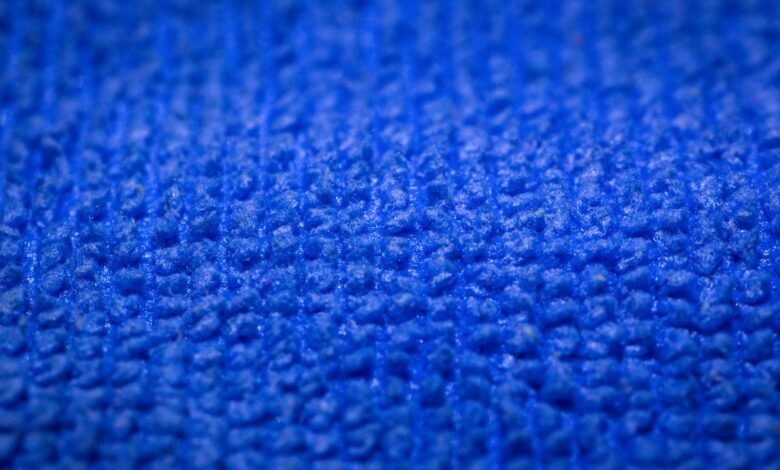
A polyester microfiber blouse keeps its drape and resists pilling when it sits in a specific mid-weight band with a tight plain or twill weave, while blouses that are too light go sheer and snag and those that are too heavy lose fluid drape and trap heat. The sweet spot is not just weight but filament fineness and cover factor working together — weight alone cannot fix a loose weave.
The trade-off is that ultra-light microfiber feels airy in store but shows lining print-through and pills at side seams within 15 wears because there is not enough yarn mass to absorb friction. A slightly heavier 110 GSM microfiber with sub-1 denier filaments drapes cleanly over trousers, holds opacity without a cami, and resists anchor pilling because the base is dense enough to lock fibers. The thresholds below let you judge drape, opacity, and pilling risk in 20 seconds.
Why microfiber GSM works differently than natural fibers
Polyester microfiber is defined by filament fineness — typically under 1 denier per filament — which makes it softer and more fluid than regular polyester. Because filaments are so fine, even at 100 GSM you get many filaments per yarn, so coverage can be good without heaviness. That is why microfiber blouses feel lighter than cotton at same opacity.
However, below about 70 GSM, even microfiber cannot maintain opacity or resist snagging because there are too few filaments to cover gaps. Above about 140-150 GSM for blouses, the fabric becomes too dense for fluid drape and starts holding heat, losing the very reason you choose microfiber for office wear. Professional blouses live in the 80-130 GSM window, with most long-wearing options at 95-120 GSM.
The three thresholds that matter for office blouses
| GSM Band | Drape & Opacity | Pilling / Snag Risk |
|---|---|---|
| <70 GSM | Very fluid but sheer, needs cami, lining shows | High — low mass, loops pull easily |
| 90-110 GSM | Best balance — opaque, fluid drape, breathable | Low-medium if weave tight |
| 110-130 GSM | Structured drape, holds shape for tucked looks | Low — dense base anchors filaments |
| >150 GSM | Stiff, less fluid, warm | Very low pilling but loses blouse purpose |
Interactive slider showing how GSM shifts a microfiber blouse between sheer, fluid, and stiff with corresponding pilling risk.
How filament denier and weave tightness modify GSM
Two blouses both listed at 100 GSM can perform differently because one uses 0.5 denier filaments with high filament count and the other uses 1.2 denier filaments with lower count. Finer filaments pack more surface area, so they cover better and feel silkier, but they need tighter weave to avoid snagging.
Weave matters: plain weave gives crisp hand and good opacity at lower GSM, twill gives softer drape and slightly better snag resistance because floats are longer and distribute friction. A loose plain weave at 100 GSM will pill faster than a tight twill at 95 GSM because cover factor is lower. Hold to light — even glow means tight cover; bright pinholes mean low density regardless of GSM.
In-store checks for microfiber blouse longevity
- Light test: Single layer to light — should be dim, even glow, no bright points. If you see your hand outline clearly, it is below opacity threshold.
- Pinch recovery: Scrunch 5 seconds, release. Good microfiber springs with minimal wrinkling; if it holds creases, filament is coarser or finish is heavy.
- Seam rub: Rub side seam with palm 5 times. If surface roughens or pills start, base density is low.
Matrix translating GSM and weave density into practical office wear recommendation.
The right GSM is 90-130, tight weave required
For polyester microfiber blouses that need to stay fluid, opaque, and pill-resistant in professional wear, aim for 90-130 GSM with 95-120 GSM as the daily sweet spot, plus a tight plain or twill weave that shows dim even glow under light. Below 70 GSM you trade durability for sheerness; above 150 GSM you trade drape for stiffness. Check light, pinch, and seam rub — those three in-store tests predict whether the blouse will last a season or a year more accurately than price.
Frequently Asked Questions
Is higher GSM always less sheer for polyester blouses?
Generally yes, but weave density and filament denier modify it. A tight 90 GSM microfiber with fine filaments can be more opaque than a loose 110 GSM with coarse filaments. Use light test alongside GSM.
Why does my microfiber blouse pill at side seams?
Side seams experience high friction from arms and bags. If base GSM is low or weave is loose, filaments break and tangle into pills that anchor because polyester is strong. Tighter weave and 100+ GSM reduces this.
Can I fix pilling on polyester microfiber?
You can trim pills with a fabric shaver on low, but prevention via cold wash inside out and avoiding high heat is more effective. Once filaments are broken, the base is weaker at that spot.