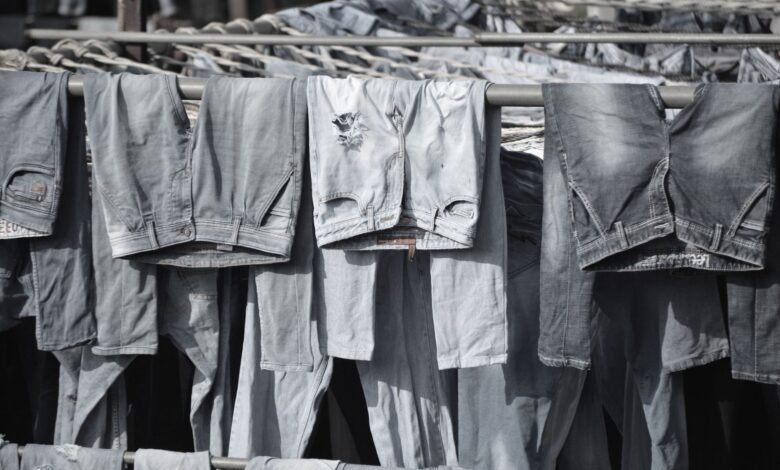
Your sustainable denim bagged at knees and faded unevenly because yarns were made from shorter recycled fibers with lower twist and looser 3/1 twill construction. That combination lowers tensile strength, makes fabric stretch without springing back, and holds surface indigo that abrades off in first few washes. It is not greenwashing, it is physics – sustainability gains came from variables that also reduced structural stability.
The trade-off is real: recycled cotton cuts water and waste, but its shorter staple needs different engineering to last, and many brands skip it. Dimensional-stability testing under AATCC 150 on this kind of denim often shows 3-5% more growth after three washes than virgin long-staple denim. Once you know which construction variables to read on product page, you can spot pairs that hold shape before buying. Here is the split that matters.
Is recycled cotton weaker or was yarn engineered wrong?
Recycled cotton is not automatically weaker but behaves differently. Mechanical recycling cuts cotton fibers 40-60% shorter, creating many fiber ends sticking out of yarn. Short-staple yarns have less surface contact to lock fibers together, so they slip past each other when you sit walk pull. That is why seat grows and knee forms bubble that does not recover. Recent tensile study on recycled-content denim shows decrease in tensile strength but increase in tear strength. Tension failure is fiber breakage, tear failure is yarn slippage. Short fibers slip easily so fabric resists propagating tear better but snaps faster under straight pull – like at crotch seam or pocket corner. Brands compound problem with low-twist open-end yarns to hit softness goals, reducing inter-fiber cohesion further. Solution is higher twist, ring-spun, core-spun with recycled poly or elastane core for resilience, and longer staple virgin blend 50-80% to anchor short fibers.
Indigo dyeing and color loss: why sustainable denim fades faster
Indigo is surface dye – it sits on outside of yarn, not penetrates core like reactive dyes. Traditional rope dyeing dips yarn 6-8 times building layers. Sustainable alternatives – sulfur agent replacing indigo (Patagonia uses 84% less water 30% less energy), foam dyeing, enzyme-assisted dyeing – use fewer dips or different chemistry for lower impact. Fewer dips = thinner color layer = faster abrasion fade. Also yarn twist matters: low-twist hairy yarn holds more surface dye initially looking deep, but hairy fibers abrade quickly exposing white core faster, creating high-contrast fade after few washes. High-twist smooth yarn holds dye more evenly and fades slower. Color fastness to washing C15 is max spec – check if brand lists it. Dark wash denim with sustainable sulfur dye will still fade but more evenly than low-dip indigo.
The construction variables that predict denim shape retention
Four variables: 1) Yarn staple and twist – long-staple combed ring-spun higher turns per inch resists stretch and bagging. 2) Weave density and GSM – heavy denim 300-600 GSM but density matters more than weight. Tight 3/1 twill at 12-14 oz with high cover factor holds shape better than loose 10 oz low density. 3) Stretch core – elastane 1-2% with polyester core-spun recovers better than bare elastane. Look for power stretch with recovery >95% after 10-second stretch test. 4) Sanforization and skew – sanforized pre-shrunk reduces 3-5% shrinkage, skew prevents leg twist. Untreated unsanforized sustainable denim can grow 3-5% after three washes per AATCC 150.
Comparison showing why short recycled fiber needs higher twist and core-spun engineering to match virgin longevity.
How to spot sustainable denim that holds shape before buying
Checklist: 1) Look for combed ring-spun, long-staple, core-spun with 1-2% elastane – not open-end. 2) Weight 11-14 oz for daily, but ask cover factor – tight weave description. 3) Sanforized or pre-shrunk, mention AATCC 150 shrinkage <2%. 4) Dye process – rope dyed 6+ dips lasts longer than foam or sulfur if you want deep indigo that fades slowly. If brand uses sulfur for sustainability, expect faster even fade, wash cold inside out. 5) Construction details – bar-tacked pockets, chain-stitched hems, hidden rivets, 4-5 stitches per cm core-spun thread. 6) Do 10-second stretch test in store: stretch knee 4 to 6 inches hold 10 sec release measure after 1 min – >95% recovery passes.
Timeline showing divergence between low-twist recycled denim and engineered recycled denim across washes.
What to do with denim that already lost shape
If already bagged, hot wash can temporarily shrink but damages short fibers more. Better: soak in cold, reshape flat dry, then wear 2-3 times before washing again – short fibers need recovery time. For color, avoid frequent washing – air, spot clean, wash inside out cold. Use pH-neutral denim wash. For future buys, prioritize construction over sustainability claim alone – a well-engineered 50% recycled 50% long-staple virgin pair worn 200 times beats 100% recycled worn 40 times and discarded on both waste and cost-per-wear.
Frequently Asked Questions
Does recycled cotton denim always lose shape?
No, if engineered with higher twist, ring-spun core-spun and blended with long-staple virgin. Low-twist open-end recycled alone loses shape faster.
Why does sustainable indigo fade faster?
Surface dye with fewer dips for water savings means thinner color layer that abrades quicker. Sulfur dyes fade more evenly but still faster than deep rope indigo.
What GSM is best for sustainable denim?
11-14 oz 300-400 GSM midweight with high cover factor holds shape better than 10 oz low density, even if both recycled content.
How to wash sustainable denim to keep shape?
Cold wash inside out, pH-neutral, air dry, avoid tumble, wash every 10-15 wears not every wear, do stretch recovery test after wash.