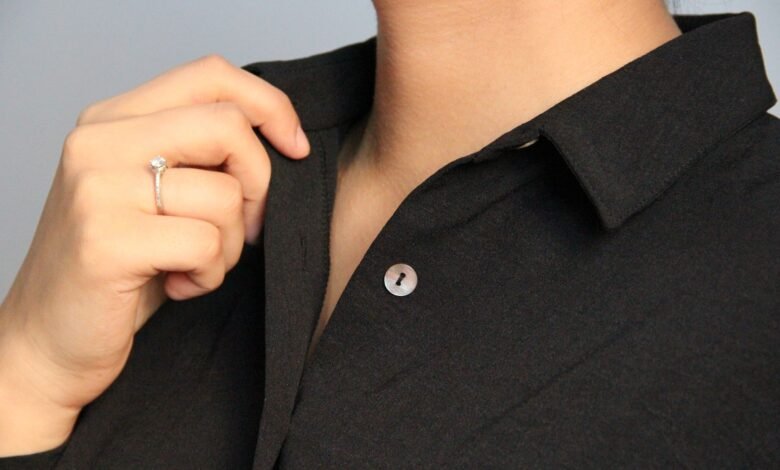
If your blouse collar wilts, curls at the points, or lifts from the neckline, you are almost always looking at low-grade fused interfacing and a single-row edge stitch. Pinch the collar: if it feels like one stiff papery board, it’s fused; if two layers slide independently, it’s sew-in. The fused version fails because its heat-activated resin softens with washing, steam, and body heat, leaving the shell to collapse on its bias.
Not all fusibles are bad — a 70-90 GSM woven fusible can beat a 30 GSM sew-in — which is why price alone misleads. The fastest tell is scrunch recovery: sew-in springs back because its shape comes from woven structure and thread tension, while fused stays creased because a softened resin bond has no spring left to give. To predict the next fifty washes, you need to read the construction — starting with why collars fail.
Why Collar Shape Fails: The Mechanics of Interfacing Breakdown
A collar is a cantilever. It has no support underneath; it must hold its weight and resist torque when you turn, button, or pull the blouse on. The stand handles vertical load, the leaf handles horizontal, and the points handle diagonal bias stress. Interfacing is the hidden engineering.
Fused systems use thermoplastic adhesive dots melted at 130-165°C to bond interfacing to shell. New, they feel crisp. Over time, water, agitation, and heat hydrolyze the resin
You see it first as micro-bubbles on the under-collar, then edge lift. Once lift starts, the outer fabric follows its bias — why silk, rayon, and fine cotton wilt first. Stress concentrates at points, so a 4 cm spear point with no stitch anchoring curls before a 2.5 cm short point.
Visual: The four-stage breakdown that turns a crisp fused collar into a wilted one — and why sew-in construction avoids it.
Sew-in interfacing is never glued. It is a separate woven — cotton organdy, hair canvas, or plain weave — sewn into the seam allowance and held by topstitching. It resists by friction and stitch distribution, not chemistry, so it cannot bubble. It will soften 10-15% over time but keeps shape because load is carried by thread lines, not by adhesive (ASTM D1683 seam strength principle).
Fused vs. Sew-In Interfacing: How to Tell and the Numbers That Predict Retention
Three checks plus three numbers give you the answer in the fitting room.
Pinch-Slide: Pinch leaf 1 cm from edge and try to slide layers. Movement of 1-2 mm = sew-in or floating canvas. No movement, slight crackle = fused.
Light Test: Hold to bright light. Pale fused collars show a regular 0.3 mm glue-dot grid and rippled edge where press missed. Sew-in shows two shadows with an air gap, no dots.
Edge Lock: Check underside where collar meets stand. Good collars show understitching 2 mm from seam to keep under-collar from rolling. Single-row 3.5 mm edge stitch = one load path. Double-row 0.2 cm + 0.6 cm = stress distributed.
Measurable markers: Shell for blouses is often 80-120 GSM. You want interfacing 45-90 GSM. Below 35 GSM nonwoven gives no memory — common in fast fashion and loses ~60% stiffness after 3 washes (ASTM D2724)
Woven interfacing has orthogonal yarns that resist bias torque like shell does. SPI: count over 2.5 cm
8-10 SPI is standard, 10-12 SPI is fine and secure, below 7 SPI perforates and curls points. Topstitch distance: ideal 0.5-0.7 cm from edge. Below 0.3 cm or above 1.0 cm leaves free edge to ripple. Point trim: good collar has 0.3-0.4 cm trimmed allowance inside point, not bulky 0.8 cm.
| Marker | Wilt-Prone | Retains Shape |
|---|---|---|
| Interfacing GSM | 20-35 GSM nonwoven | 50-90 GSM woven fusible or 40-70 GSM sew-in |
| SPI / Rows | 6-7 SPI, 1 row | 10-12 SPI, 2 rows (0.2 + 0.6 cm) |
| Edge Distance | 0.2-0.3 cm or >1.0 cm | 0.5-0.7 cm |
| Point Trim | >0.7 cm bulky | 0.3-0.4 cm trimmed |
Visual: Where each of the three numbers falls on the spectrum between failure risk and durable construction.
The 10-Second In-Store Diagnostic You Can Do Without Tools
Decision flow for the three timed checks — two or more low-GSM/single-row results predict wilting within 10 cold washes.
0-3 sec — Scrunch: Fist the point for 3 seconds. Sharp white crease that stays = cheap fused. Soft spring back = sew-in or good woven fusible. Plastic memory vs cloth elastic recovery.
3-6 sec — Snap: Hold leaf horizontal, flick point. Good collar vibrates once and stops. Wilt-prone flops with no recoil. Tests flexural rigidity from GSM and bond integrity.
6-10 sec — Peek and Tug: Flip to collar band underside. Look for understitching 2 mm from seam and narrow allowance inside. Tug band lightly
If it moves as one glued piece with 3-4 mm peeking, expect bubbling. If stand shows two stitch lines through all layers, that’s load-sharing.
If two checks point to low-GSM fused plus single-row stitch, it will wilt within 10 cold washes. No matter the brand label, skip it.
What Happens After 10-20 Washes: Durability Curves and Attachment Methods
Washing is accelerated aging: flex cycles, fiber swelling, resin re-softening. Lab hierarchy (ASTM D2724 wash appearance, D1683 seam fatigue) is consistent:
Low-GSM nonwoven fused fails 3-7 washes — edge lift, then center bubble. Mid-weight 70 GSM woven fusible with 52-dot coating holds 15-25 cold washes if hang-dried. Sew-in woven holds past 40 washes — it softens 10-15% but never delaminates, so appearance stays acceptable if topstitching holds.
Attachment method shifts the curve. Edge-stitch only lets margin lift once bond weakens. Edge + understitch + 0.2 cm staystitch on under-collar pins interfacing on three lines, so stitch carries load even if glue weakens. That’s why men’s shirts — woven fusible plus double topstitch plus separately interlined band — stay crisp for years while unlined blouse collars collapse.
Care: For fused, wash cold, tumble low only, never steam face directly, press from underside at 110°C with press cloth. High heat on face re-melts resin unevenly and causes irreversible shine.
~20% at 20
~65% at 20
~88% at 20
Visual: Shape retention after 20 cold washes drops off fastest for low-GSM fused and holds best for sew-in with double stitching.
Quality Tiers Decoded: What to Buy and What to Avoid
Match construction to wear frequency.
| Tier | Construction Signals | Best For |
|---|---|---|
| Fast Fashion (Avoid for collars) | 20-35 GSM nonwoven fusible, 7 SPI single row at 0.2 cm, >0.7 cm allowance, no understitch | <10 wears |
| Mid-Market Good | 50-70 GSM woven fusible, 10 SPI double row, 0.5 cm edge + understitch, band separately interlined | Weekly work — 15-20 washes |
| Long-Retention (Buy) | 60-90 GSM sew-in canvas + 10-12 SPI double topstitch 0.5-0.7 cm, 0.3 cm point trim | Silk/poplin investment — 40+ washes |
What to avoid: Interfacing stopping 1 cm short of edge — soft unsupported margin rolls first. Good makers carry to 0.2-0.3 cm. Laser-cut fused edges with no bartack at point tip — highest stress concentration curls
Loud crackle — heavily sized nonwoven that loses finish after first wash (ASTM D1777 thickness loss). And exaggerated cardboard stiffness in-store — bends 30-40° and recovers is ideal, not 90° rigid; extreme stiffness signals early brittleness.
Online, zoom collar underside photos. Interior 0.2 cm understitch, narrow edge stitch, no fusing shine = positive even if description says nothing.
Buy the Collar That Still Points After a Year
Wilted collars are engineered at the pattern table by three choices: interfacing GSM and weave, fused vs sew-in, and how many stitch rows share load. Low-GSM nonwoven fused with single-row stitch is built to fail before wash ten. Dense 70+ GSM woven fusible with double anchoring can work, and 60-90 GSM sew-in with 10-12 SPI keeps pointing past year one
Run scrunch-snap-peek, count SPI over an inch, feel for slide. You’ll know in the fitting room what others learn after laundry.
FAQ
Can a dry cleaner fix a bubbled fused collar?
Temporarily. Re-pressing at 130°C can re-bond small areas, but migrated resin never regains original strength. If bubbling covers >30% of leaf, have a tailor replace with sew-in ($15-25) instead of repeated re-fusing.
Is sew-in always better than fused?
No. An 80 GSM woven fusible with 52-dot coating and double-needle 10-12 SPI can beat a 30 GSM sew-in organza left with 0.8 cm loose margin. Best predictor is GSM plus attachment rows, not just fused vs sew-in. Luxury shirting often prefers woven fusible for clean edge without bulk.
How do I measure SPI without tools?
Thumbnail is ~1.2 cm. Count across two thumbnails (~2.4 cm). Eight to nine stitches there is roughly 9-10 SPI
Under 8 stitches per 2.5 cm is sparse and will curl. Photo with phone Measure app at 2.5 cm scale works too.
Does fabric change which interfacing lasts?
Yes. Silk and rayon swell more, so need woven interfacing with similar bias behavior — ideally sew-in. Cotton poplin is stable and works with mid-weight woven fusibles. Polyester can tolerate nonwoven longer because it doesn’t swell, but still needs double-row stitching to prevent edge curl from torque.